

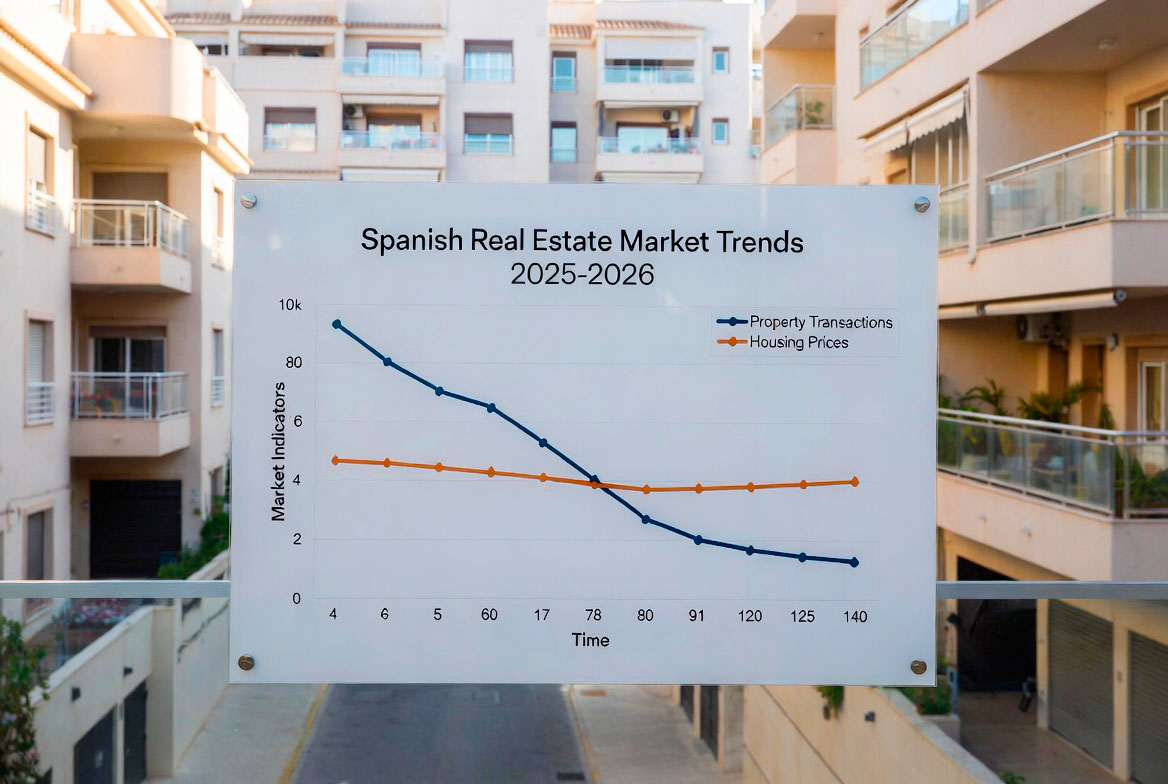
The real estate market in Spain has entered a cooling phase in 2026, with a decline in the number of property transactions and a slowdown in price growth, according to analysis published by
El País.
This shift does not indicate a crisis, but rather an evolution toward a more demanding market, where financing conditions, housing supply, and buyer profiles play a decisive role.
In this article, we analyze what is happening, why it is happening, and what this new scenario means for buyers, sellers, and investors.
Table of Contents
- Introduction: From boom to adjustment
- What is really happening in the market
- Key data behind the market slowdown
- Crisis or cycle change?
- Lack of supply: the real issue
- Price trends in 2026
- Falling transactions: the real causes
- The impact of Euribor
- The profile of today’s buyer
- How it affects sellers
- Impact on investors
- Situation on the Costa del Sol
- Market outlook 2026–2027
- Summary table
- Frequently Asked Questions (FAQs)
- Conclusion
Introduction: From boom to adjustment
After several years of strong growth driven by the post-pandemic recovery, the Spanish real estate market is now showing clear signs of slowdown. This is not a sudden drop, but rather a gradual adjustment toward a more balanced environment.
What is really happening in the market
The market is not collapsing; it is adjusting. While there are fewer transactions, demand still exists, but it is now filtered by financial constraints.
Key data behind the market slowdown
- Approximately 10%–11% decline in property transactions
- Increased difficulty in accessing financing
- Euribor at elevated levels
- Reduction in the number of active buyers
Crisis or cycle change?
This is not a real estate crisis like 2008. The current context is very different: there is no excess supply, the financial system is more cautious, and buyers are more financially prepared.
Lack of supply: the real issue
The key factor supporting prices is the shortage of available housing. Spain faces a structural housing deficit due to limited new construction, scarcity of developable land, and sustained demand in key areas.
Price trends in 2026
Prices continue to rise, but at a slower pace. Forecasts suggest increases between 6% and 10%, compared to stronger growth in previous years.
Falling transactions: the real causes
The decline in transactions is not due to lack of interest, but lack of purchasing capacity. Stricter lending conditions and higher mortgage costs are limiting access to the market.
The impact of Euribor
Rising Euribor rates have increased mortgage costs, reducing borrowing capacity and slowing down purchase decisions.
The profile of today’s buyer
Today’s buyer is more analytical, cautious, and demanding. Decisions are slower and based on financial evaluation.
How it affects sellers
Sellers must adapt to a less dynamic market by setting realistic prices and applying clear sales strategies.
Impact on investors
This environment creates opportunities for investors, with less competition and better negotiation conditions.
Situation on the Costa del Sol
In areas such as Benalmádena or Marbella, strong international demand maintains price pressure and market resilience.
Market outlook 2026–2027
The most likely scenario includes fewer transactions, stable or moderately rising prices, and a more balanced market.
Summary table
| Indicator | 2025 | 2026 | Trend |
|---|---|---|---|
| Transactions | High | Medium | Decreasing |
| Prices | +15% | +8% | Slowing growth |
| Euribor | Medium | High | Restrictive |
| Supply | Low | Very low | Critical |
| Demand | High | Selective | Filtered |
Frequently Asked Questions (FAQs)
Will housing prices fall in 2026?
No, due to the lack of supply.
Is it a good time to buy?
It depends on financial capacity, although there is less competition.
Is it a good time to sell?
Yes, but it requires the right strategy.
Will there be a real estate crisis?
No in the short term.
Conclusion
The Spanish real estate market is not collapsing; it is evolving into a more professional and demanding environment.
More information:
Real estate in Benalmádena
Property auctions
Debt sales


